The business problem
A media asset becomes useful only after the platform can connect the uploaded file with its metadata, processing status and downstream campaign context. Uploading a large video, preparing derivatives and waiting for analysis are different operations with different failure modes. If the API treats them as one request, a browser timeout can leave the user unsure whether to upload again, wait or contact support.
The broader application also manages agencies, media, campaign proposals, matching results and conversational history. Those relationships make status part of the product experience: a campaign should not appear ready simply because a file exists in object storage. The backend needs to coordinate durable records and background work, while the interface needs enough information to represent pending, failed and completed states honestly.
Delivery scope & the inspected boundary
The inspected source is the REST API repository. It contains a TypeScript API, database models and migrations, media upload controllers, cloud service adapters, background-processing entry points and Lambda handlers. Models cover media and derived analysis alongside agency and campaign entities. This report explains backend implementation and its application-facing contracts; it does not imply that an uninspected frontend or every possible user journey has been verified.
A complete application delivery around this backend would connect authenticated media intake, upload progress, metadata editing, processing visibility and campaign workflows. The implementation already separates upload initiation, multipart completion and media creation. That separation is useful because storage completion and business-record creation are distinct events. The user should receive a clear next state after each, including a recoverable response when processing has not yet begun.
Backend implementation: upload to background work
Upload controllers call AWS helpers to generate signed URLs and initiate multipart uploads. Separate handlers support completion and abort. These contracts let large binary transfers use object storage while the API coordinates ownership and metadata. The signed-upload path must be evaluated alongside its expiry and object permissions during a real deployment; this source review does not assert a particular production bucket policy.
AWS service code imports S3, SQS and ECS clients. The worker Lambda receives queue records and starts an ECS preprocessing task with serialized message data. Its exception path updates affected media records to a failed state and clears their lock. Dedicated image-processing code reads and writes S3 objects and uses image-processing utilities; other handlers cover video and analysis status concerns. These are concrete asynchronous responsibilities rather than one generic AI endpoint.
The source also includes Google Cloud Storage, Google video-transcoder, Pub/Sub and Vertex AI service modules. Vertex AI is used through an explicit adapter; GCP storage and transcoding support represent additional cloud responsibilities. The architecture is therefore mixed AWS/GCP. The presence of these modules establishes integrations in the codebase, not that every adapter is enabled in every environment or that a single asset always traverses every provider.
Actual source mix & a separate AWS reference
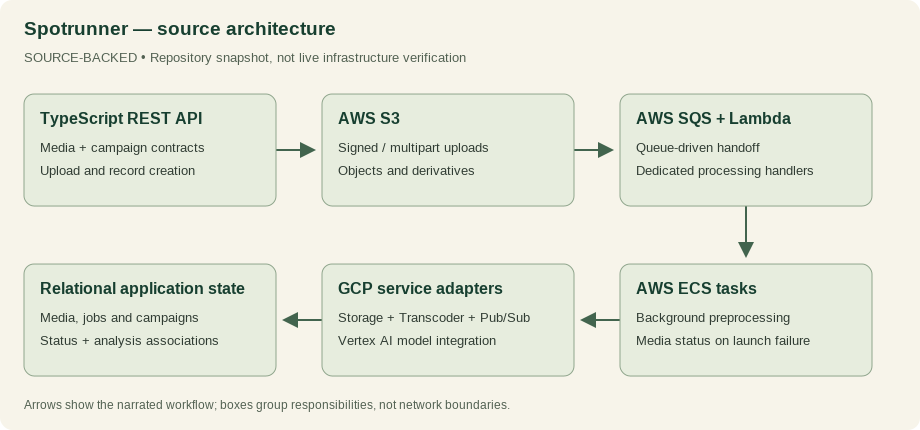
The first diagram groups the source-backed upload and processing responsibilities and explicitly marks the GCP adapters. Arrows describe the narrated application workflow, not a claim that each shown cloud service directly invokes the next. Database job and media state tie these asynchronous components back to application records. The repository includes relational models and migrations; this diagram avoids inferring an unverified managed database product.
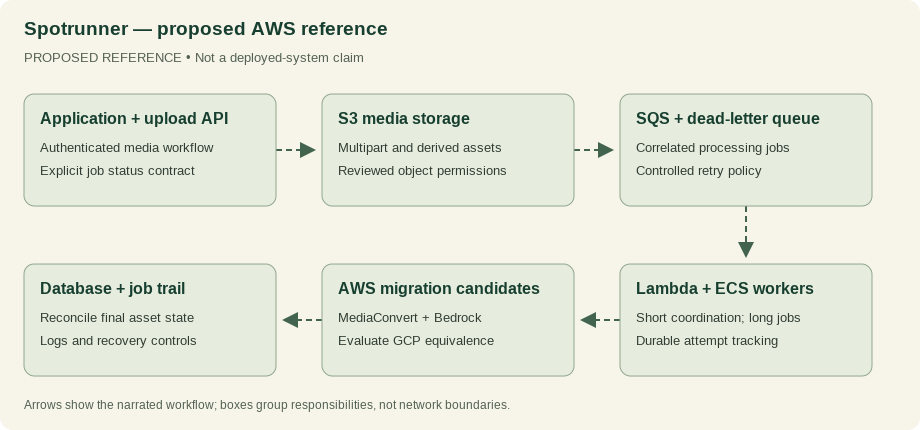
The second diagram is a proposed AWS reference, not an AWS-only description of the existing system. Retaining S3, SQS and ECS fits the inspected worker structure. Moving GCP responsibilities to AWS alternatives would require separate evaluation of transcoding output, model behavior, supported media, cost and data handling. Proposed MediaConvert or Bedrock components are migration candidates, not services proven in this source.
POC walkthrough: a synthetic media job
Use a fabricated agency, campaign and media asset in a disposable environment. The sample clip should be generated or otherwise cleared for testing, with no client footage or account identifiers. The sequence below is an acceptance design, not a recording of a live system.
- Complete a controlled upload. Request multipart upload instructions for a synthetic clip, send sample parts, complete the upload and create its media record. Verify that the application associates the intended object with the expected media entry. Exercise abort with a second incomplete upload.
- Observe asynchronous work. Trace the created media through queue input, the worker Lambda and the ECS preprocessing task. Inspect status changes independently of the original browser request. Closing the browser should not be treated as cancelling a durable job.
- Inspect provider boundaries. Enable only the selected test adapters. For a GCP analysis path, capture sanitized input and output metadata at the adapter boundary. Confirm which services actually ran instead of treating the full dependency list as one proven pipeline.
- Trigger and explain a failure. Simulate a failed task launch and inspect the media failed state and lock handling. Retry only after checking whether work already started. Feed a duplicate job in a separate fixture and assess whether an additional guard is needed before production acceptance.
Reliability is visible product behavior
Moving preprocessing into a background task helps the API return without holding a connection for the lifetime of a large operation. It also introduces a handoff boundary: receiving a queue message, launching a container and completing the work are three different events. A launch acknowledgement cannot by itself prove that the asset is ready. Durable status and a supportable job trail are therefore central application features.
The inspected Lambda catches launch errors and patches media records. A production readiness review should examine queue acknowledgement and redelivery behavior around that catch, plus errors occurring after task launch. This report does not claim exactly-once processing or complete retry coverage. Those properties need explicit tests and a durable strategy for correlating attempts, detecting completed work and preventing duplicate side effects.
Cross-cloud processing adds practical coordination work. Object references, derivative locations and analysis responses need consistent association with a media record. Provider errors should remain distinguishable from unsupported input or invalid business state. Sanitized logs should help identify the failed stage without copying signed URLs, credentials or client media into routine support output. These are proposed acceptance requirements, not claims that every safeguard was established by reading imports.
Evidence, limits & delivery acceptance
The report draws from media upload controllers, the AWS helper module, the worker and image Lambda handlers, GCP storage and Pub/Sub adapters, the Vertex AI adapter and the model layout. That evidence supports a mixed-cloud backend with asynchronous work. It does not establish present deployment topology, processing latency, model quality, completed frontend delivery or customer campaign performance. No invented operational metrics are included.
A meaningful next delivery would choose one supported media type and follow it from upload to usable result, including an incomplete upload, task failure and controlled retry. Campaign-facing behavior would then be verified against those states. The goal is a platform where the user can understand what has finished, what is still processing and what requires action, even when the work crosses cloud and process boundaries.
Stride / Ahmedabad
Bring the workflow into focus.
Discuss the business process, integration boundaries and acceptance evidence for your next application.
Talk to Stride →